The Tracking Dog – Blood Science
Understanding the chemical signatures that empower dogs to track wounded game
Dogs possess one of nature’s most sophisticated detection systems. Their ability to track wounded or dying deer relies on complex chemical signals that are completely invisible to humans — and frequently misunderstood, even within the tracking community.
This page examines the peer-reviewed research on what dogs actually detect when tracking: the volatile organic compounds (VOCs) in blood, the stress hormone byproducts released by wounded animals, and the remarkable sensitivity of the canine nose. The science tells a different story than some of the claims circulating in tracking circles.

It’s Not a Line, It’s a Landscape: The Rich Complexity of a Scent Trail
Scientific literature makes a crucial distinction between two concepts that are often used interchangeably:
• Tracking refers to following ground disturbance — crushed vegetation, disturbed soil, and shifts in biological ground activity created as an animal moves through the environment.
• Trailing refers to following individual scent left behind, composed of skin cells, secretions, and volatile compounds unique to that animal.
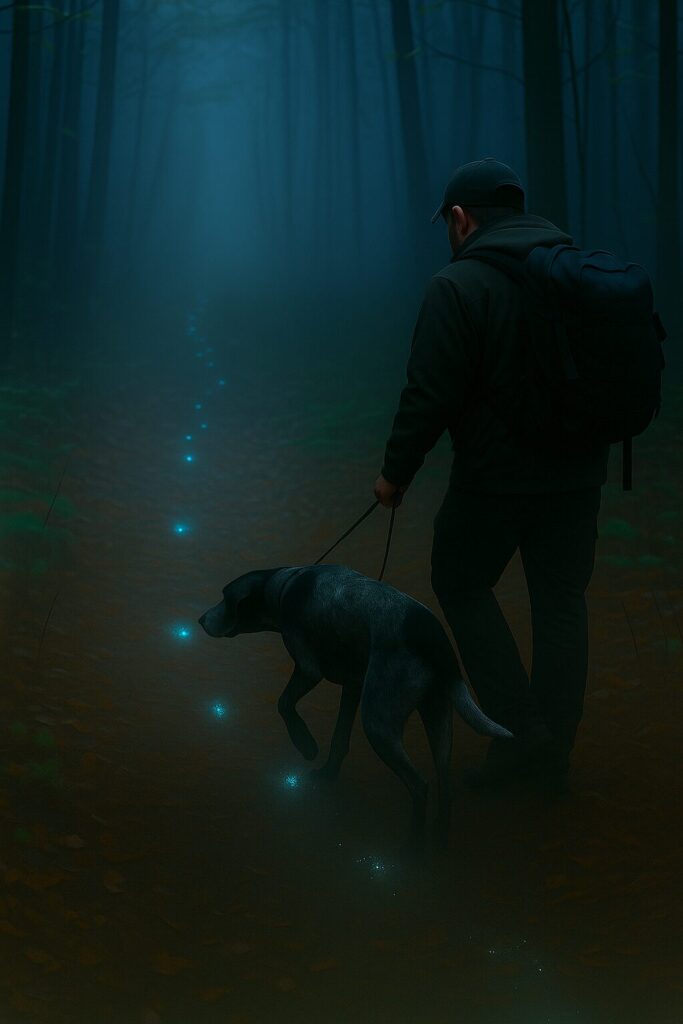
A dog working a blood trail isn’t following a simple line. They’re navigating a rich landscape of information. Research on mammals like white-tailed deer and reindeer shows that secretions from interdigital glands leave complex chemical messages about dominance, sex, and social status — not just markers of presence.1
When your dog is on a trail, they’re reading a detailed story written in a chemical language we can’t perceive: a multi-faceted landscape of information left by the animal’s passage.
Blood IS Detectable: The “Metallic Blood” Compound
Claim: “Dogs don’t really care about blood, it’s not valuable for tracking.”
The Research: Blood has a powerful, specific chemical signature that triggers innate predatory responses in carnivores.
Researchers have identified a specific chemical called trans-4,5-epoxy-(E)-2-decenal that gives mammalian blood its distinctive metallic odor.2 This single compound is so powerful that it can trigger the same behavioral responses in predators as real blood.
Studies with captive large carnivores — Asian wild dogs, African wild dogs, and Siberian tigers — showed remarkable results. When presented with wooden logs containing either real blood odor or just this single synthetic compound, the animals displayed intense interest: sniffing, licking, and even guarding the scented objects as if protecting actual prey.2,3
Key finding: One chemical compound alone can be as effective as real blood for triggering predator detection and tracking behaviors.
This is not “just iron.” Iron (Fe) is a metal, not a volatile organic compound. The metallic smell of blood comes from trans-4,5-epoxy-(E)-2-decenal and other VOCs, not from the iron content itself.2
Blood Does NOT Disappear: Chemical Stability and Persistence
Claim: “Blood is so volatile it basically disappears overnight.”
The Research: Blood produces a continuously evolving stream of volatile organic compounds (VOCs) that persist for days and weeks, not hours.
The First 48 Hours: A 2025 study by Whaley et al. profiled blood scent in detail during this critical window.4 They identified multiple distinct odor profiles:
• Fresh blood (1-4 hours old): Dominated by aromatics and hydrocarbons
• Intermediate phase (8-24 hours): Transitional mixture of compounds
• Aged blood (32-40 hours): Characterized by aldehydes and ketones
This means blood doesn’t simply “evaporate” — it transforms into different chemical signatures over time.
Beyond 48 Hours: Research from Rendine et al. (2019) demonstrates that blood continues to produce detectable VOCs well beyond the initial 48-hour window.5 Around day 7 and beyond, sulfur compounds like dimethyl disulfide and carbon disulfide begin to appear, adding another distinct chemical signature.
Detection of Extremely Small Quantities: Research has experimentally demonstrated canine capability to locate minute quantities of aged blood:
• Dogs successfully located approximately 1 mg (two drops) of human blood on carpet squares aged for weeks — with no false alerts.6
• Another study confirmed detection of blood volumes as small as 0.1 mL up to 32 hours post-deposition.7
Key finding: Blood remains detectable by trained dogs for days to weeks, not hours. The chemical signature evolves but does not disappear.
It’s NOT Just Iron: Training Implications of Complex VOC Profiles
Claim: “Dogs only smell the iron in blood.”
The Research: Blood produces dozens of volatile organic compounds. Iron (Fe) is not volatile and does not contribute to the scent signature.
Blood releases Volatile Organic Compounds (VOCs) continuously. These volatile molecules have specific physicochemical properties: low molecular weight, high vapor pressure, and low boiling point.2,4,5 High vapor pressure means these molecules readily escape into the surrounding environment, allowing scent to propagate away from the source. This creates a persistent, detectable trail.
The Changing Chemical Signature: The Whaley et al. study included canine trials that produced a critical finding:4
Canines trained on older blood had difficulty detecting the fresh blood (1–2 h old) and had the greatest detection rate for the aged blood (34–36 h old).
This has profound practical implications: A dog trained exclusively on aged tracks may not recognize the chemical signature of a fresh one. To be truly effective, a detection dog must be trained on scents of various ages to learn the full spectrum of the target odor’s evolution.
This could explain why some dogs show little interest in certain tracks — they may not have been exposed to that particular chemical profile during training. Important note: If a deer is still alive and actively bleeding, the blood is in the “fresh” range (1-4 hours), which has a distinctly different VOC profile than aged blood.
Survival Against Cleaning: Even when blood appears invisible to the naked eye, trace evidence remains detectable. In studies using cotton swatches, presumptive chemical tests like luminol remained effective in detecting blood washed up to five times with standard household detergent.8
Key finding: Blood is not a single “iron smell” — it’s a complex, evolving mixture of volatile compounds that dogs can detect across multiple decomposition stages.
Hormones, NOT “Health Status Pheromones”
Claim: “Dogs track wounded deer by detecting health status pheromones.”
The Problem: This terminology is scientifically incorrect. There is no peer-reviewed research supporting the existence of “health status pheromones” in deer or other mammals.
Understanding the Distinction: Hormones are for communication within your body. Pheromones are for communication with others.
What Dogs Actually Detect: Dogs can detect the volatile organic compounds (VOCs) produced as byproducts of the stress response — specifically, the two main stress systems:
• The SAM axis (Sympathetic-Adreno-Medullar): The fast-acting “fight-or-flight” system that releases adrenaline and noradrenaline.
• The HPA axis (Hypothalamic-Pituitary-Adrenal): The slower, sustained system that releases glucocorticoids like cortisol.
Research: Dogs Can Smell Fear and Stress
A groundbreaking 2024 study by Kiiroja et al. confirmed that trained dogs can discriminate between breath samples taken from people in calm states versus stressed states with approximately 90% accuracy.10 The dogs were detecting VOCs produced by stress hormone activity — one dog’s performance correlated with donors’ self-reported fear (SAM axis activation), while another correlated with shame (HPA axis activation).
Evidence from Other Species: Rats avoid paths covered with blood from stressed rats but not from non-stressed rats, demonstrating that stress-related chemosignals are present in blood itself.11 A wounded or dying deer would be in a state of extreme stress, releasing these detectable chemosignals.
Dogs demonstrate olfactory generalization — they can spontaneously learn to respond to variations of a target odor by recognizing common properties across different individuals and contexts.10
Key finding: Dogs detect stress hormone byproducts (VOCs), not “health status pheromones.” A wounded deer experiences massive stress, releasing detectable cortisol and adrenaline byproducts.
Why Wounded Deer ARE Trackable: Integration of the Evidence
The research supports a clear conclusion: Dogs can track wounded or dying deer by detecting the combined chemical signature of blood VOCs and stress hormone byproducts.
1. Blood Provides a Reliable Chemical Trail
• Trans-4,5-epoxy-(E)-2-decenal triggers innate predatory responses2,3
• Blood VOCs persist for days to weeks4,5,6,7
• Dogs detect blood at extraordinarily low concentrations6,7
2. Stress Hormones Add a Distinct Signal
• Wounded animals experience extreme physiological stress
• Stress activates SAM and HPA hormone systems
• These systems produce detectable VOC byproducts10
• Dogs can generalize stress signals across species10,11
3. Deer Scent Reflects Hormonal Status
Research on white-tailed deer shows that interdigital gland secretions (which create the scent trail) are under hormonal control.12 Androgenic hormones like testosterone influence sebaceous gland activity and volatile compound production. If normal hormonal fluctuations (dominance, reproduction) create detectable scent changes, then extreme stress from wounding creates a dramatically altered volatile profile.
4. Multi-Sensory Integration
Dogs don’t track using a single cue. They integrate:
• Blood VOCs (trans-4,5-epoxy-(E)-2-decenal, decomposition compounds)
• Stress hormone VOCs (byproducts of cortisol/adrenaline)
• Ground disturbance (crushed vegetation, disturbed soil)
• Interdigital gland secretions (hormonal status markers)
This creates a comprehensive chemical landscape far richer than any single “health status pheromone” could provide.
Practical Training Implications
Based on the research reviewed here, effective blood tracking training should include:
1. Exposure to multiple blood ages: Fresh (1-4 hours), intermediate (8-24 hours), and aged (32+ hours) profiles4
2. Recognition that live vs. dead animals produce different signatures: A still-living wounded deer produces “fresh” blood chemistry
3. Understanding that blood + stress VOCs create the full tracking picture
4. Realistic expectations about persistence: Blood trails remain detectable for days to weeks, not just hours
Understanding Hormones and Pheromones
When we think about the chemical messengers that influence our bodies and behaviors, two terms often come up: hormones and pheromones. While both are crucial for communication, they operate in fundamentally different ways.
What Are Hormones?
Hormones are chemical messengers produced by the endocrine glands within an organism. They travel through the bloodstream to target specific cells or organs, regulating physiological processes like metabolism, growth, mood, and reproduction.
What Are Pheromones?
Pheromones are chemical signals released by an organism into the external environment. They are detected by other individuals of the same species and trigger specific behavioral or physiological responses — such as finding mates, marking territory, or alerting to danger.
The Key Differences: Hormones vs. Pheromones
| Feature | Hormones | Pheromones |
|---|---|---|
| Target | Cells or organs within the same organism | Other individuals of the same species |
| Communication Type | Internal (within the body) | External (between individuals) |
| Mode of Action | Travel via the bloodstream | Released into the environment and detected externally |
| Function | Regulate internal physiological processes | Trigger behavioral or physiological responses in others |
| Detection | Detected by specific receptors on target cells | Detected by specialized sensory organs (e.g., vomeronasal organ) |
In essence: Hormones are for communication within your body via blood, while pheromones are for communication with others – of the same species!
References
- Müller-Schwarze, D. (2006). Chemical Ecology of Vertebrates. Cambridge University Press.
- Perl, T., & Steiner, P. (2012). The characteristic smell of mammalian blood: trans-4,5-epoxy-(E)-2-decenal. Angewandte Chemie International Edition, 51(21), 5207-5210.
- Jürgens, A., El-Sayed, A.M., & Suckling, D.M. (2009). Do carnivores use common volatile blood compounds for prey location? Chemical Senses, 34(9), 753-760.
- Whaley, F., Albizu, V., Cruz, J., Dargan, R., & DeGreeff, L. (2025). Investigation of distinct odor profiles of blood over time using chemometrics and detection canine response. Forensic Chemistry.
- Rendine, M., Fiore, C., Bertozzi, G., De Carlo, D., Filetti, V., Fortarezza, P., & Riezzo, I. (2019). Decomposing human blood: Canine detection odor signature and volatile organic compounds. Journal of Forensic Sciences, 64(2), 587-592.
- DeGreeff, L. (2018). Use of canines to detect dried human blood and instrumental methods for the determination of odor profiles. Proceedings of the American Academy of Forensic Sciences, 69th Annual Scientific Meeting.
- Skalleberg, A.G., & Bouzga, M.M. (2016). Detecting and collecting traces of semen and blood from outdoor crime scenes using crime scene dogs and presumptive tests. Forensic Science International, 264, 146-152.
- Johnston, E., Williams, S., & Prichard, J. (2018). Investigating the detection limits of scent-detection dogs to residual blood odour on clothing. Forensic Science International, 13, 4-10.
- Craven, B.A., Paterson, E.G., & Settles, G.S. (2010). The fluid dynamics of canine olfaction: Unique nasal airflow patterns as an explanation of macrosmia. Journal of the Royal Society Interface, 7(47), 933-943.
- Kiiroja, L., Kalmet, M., Pärnamets, P., de Groot, J.H.B., Semin, G.R., & Webb, T.L. (2024). Dogs can discriminate between human odours from fear and non-fear contexts. Animal Cognition, 27, 62.
- Mackay-Sim, A., & Laing, D.G. (1980). Discrimination of odors from stressed rats by non-stressed rats. Physiology & Behavior, 24(4), 699-704.
- Gassett, J.W., Ballard, W.B., Sparrowe, R.D., & Verme, L.J. (1982). Interdigital gland in white-tailed deer: Function and variation. The Journal of Wildlife Management, 46(3), 689-697.
Scientific Insights into Canine Tracking Abilities
Explore groundbreaking research detailing how blood, hormones, and pheromones influence a dog’s unparalleled tracking skills.
1
Hormone Detection
Dogs detect subtle variations in stress hormones, linking human emotional states to tracking efficacy.
2
Environmental Cues
Tracking relies on cues like crushed vegetation, disturbed earth, and volatile organic compounds emitted by wounded animals.
3
Multi-Sensory Integration
Canines combine blood VOCs, stress hormones, and environmental signals to form a comprehensive scent profile.
4
Tracking Success Rate
Studies confirm a high success rate in tracking wounded animals by combining multiple scent and visual stimuli.
The Science Behind Canine Detection
Dive into the fascinating biology of blood, hormones, and pheromones and their crucial role in dogs’ exceptional tracking abilities.
Coming Soon, track training steps and guides!

Understanding Blood and Hormones
Explore how blood components and stress hormones serve as vital clues that dogs instinctively detect during tracking.

Interpreting Chemical Signals
Learn how volatile organic compounds help dogs identify wounded animals by reading environmental scents.

Integrating Multisensory Cues
Discover how dogs combine cues from crushed plants, disturbed soil, and animal dander to track with remarkable precision.
Discover the Science Behind Canine Tracking
Delve into detailed visuals illustrating the intricate biological and chemical processes that empower dogs to track with remarkable precision.